AI check for owner-managed firms in the EU and UK
Find out which EU AI Act rules apply to your AI tools.
You use AI at work, and the AI Act applies now. The check is free. It sorts each of your AI tools by risk level and names your next step.
Not legal advice.
Where you stand
Since 2 August 2026 the AI Act applies generally. The ban on prohibited practices has applied since 2 February 2025. So has Art. 4 on AI literacy; in its version since 27 July 2026 it requires measures for staff (so people use AI safely). This check covers the EU AI Act.

A worked example
A company with 60 people uses ChatGPT, Copilot and a chatbot on its website, and is based in the EU. The question is which use the AI Act covers.
- ChatGPT. Risk depends on the use: minimal for texts. Duty: AI literacy measures for staff. Next step: list each use.
- Copilot. Minimal for code and documents. Duty: AI literacy measures for staff. Next step: check any use in hiring, which is high risk.
- Website chatbot. Transparency duty (Art. 50): visitors must know they talk to an AI. Next step: add that notice.
Sources and article numbers: see "Sources and deadlines" below.
In the UK, when the EU is affected
It applies to you if you use AI in the EU, offer AI on the EU market, or your AI output is used in the EU. The AI Act does not stop at the EU border. It also applies to providers and deployers outside the EU when the output of their AI is used in the Union.
How the check works
- You name the AI uses. Where AI runs or is planned to run.
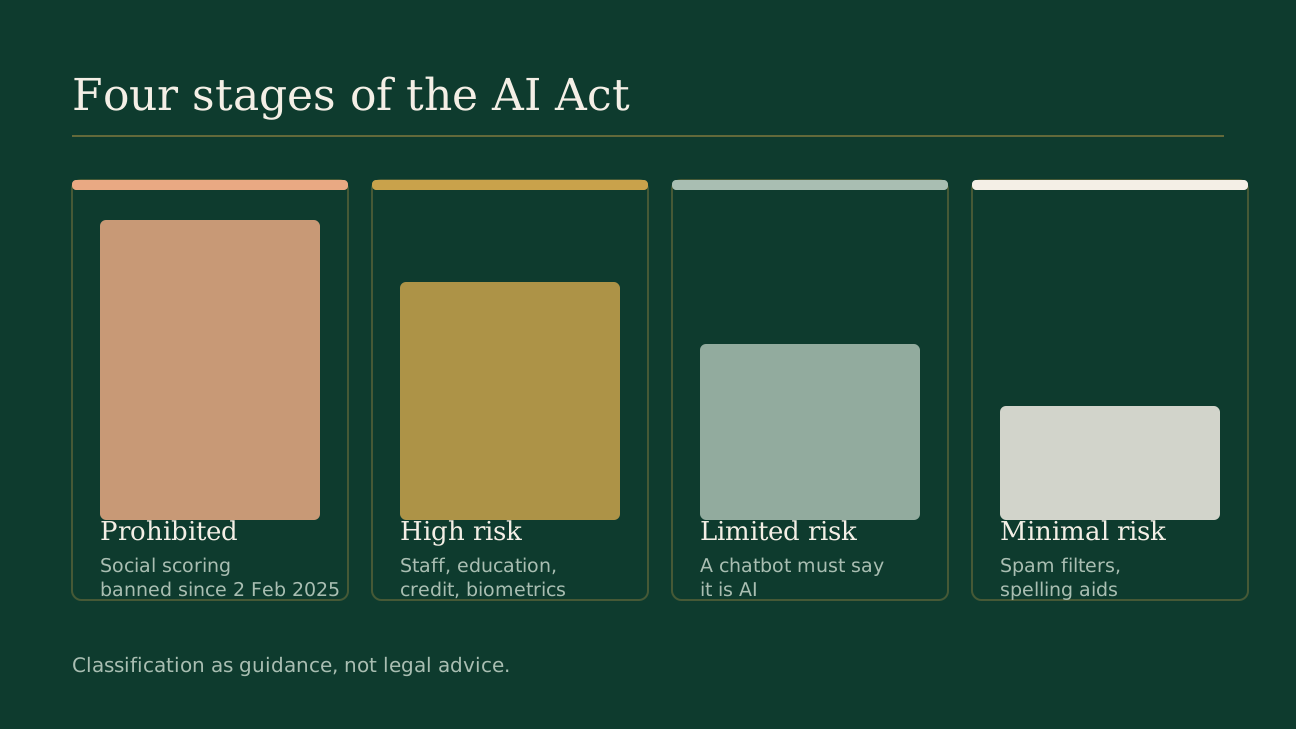
- We classify each use. Prohibited, high risk, limited risk or minimal risk.
- You receive the classification and the next step. In writing, with reasons.
What the classification is, and is not
It shows where your AI uses stand and which duty counts first.
Until 31 December 2026 the check is free. After that, you decide whether to take the implementation with us. Implementation is priced by effort.
Frequently asked questions
What does the AI check look at?
Where AI already runs in your company, or is planned to run, and which AI Act risk class each of these uses falls into.
Is the check legal advice?
No. The classification is guidance. For a binding legal opinion you need a lawyer.
What does it cost?
Free until 31 December 2026. After that, you decide whether to take the implementation with us. Implementation is priced by effort.
Which companies is it for?
Any owner-managed company that uses AI in the EU, or whose AI output is used there. Most have 20 to 250 employees.
Does the AI Act apply in the UK?
Yes, if the output of your AI system is used in the EU. The AI Act then also applies to providers and deployers outside the EU.
Sources and deadlines
- 2 Feb 2025Prohibited AI practices and AI literacy (Art. 4) apply.
- 2 Aug 2025Rules for general-purpose AI models apply.
- 2 Aug 2026The AI Act applies generally, with exceptions.
- 2 Dec 2027High-risk rules for areas such as biometrics, critical infrastructure and education, moved to this date by the Digital Omnibus on AI, the EU law that changed the deadlines in 2026.
- 2 Aug 2028High-risk rules for AI in regulated products.
Source: European Commission, Regulatory framework for AI, digital-strategy.ec.europa.eu, retrieved 31 Oct 2026; Regulation (EU) 2024/1689, as amended by the Digital Omnibus on AI, Regulation (EU) 2026/1744, in force since 27 July 2026.
Scope: Regulation (EU) 2024/1689, Art. 2(1)(a) to (c).
Duties: AI literacy, Art. 4; transparency, Art. 50.
The letter: at most once a week
You would rather read first, then ask? The letter brings you three things.
- One ideaWhat AI does today in a company like yours.
- One caseMeasured, with date and number.
- One next stepThat you can take the same day.
Your next step
Tell us where AI already runs in your company. We reply with the classification.
Request the checkMore: Metatron.